
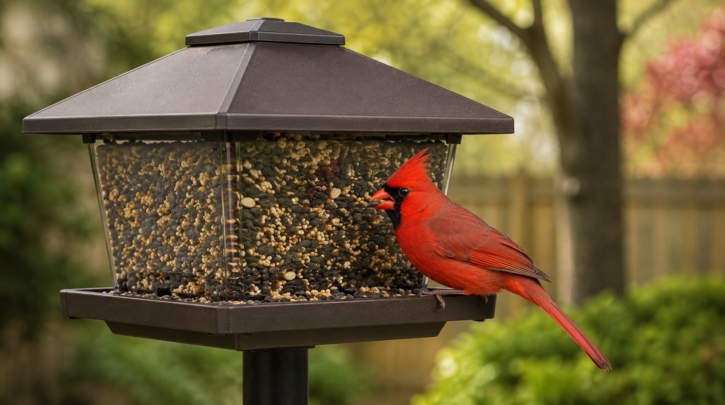

The single most important thing about a cardinal feeder is that it gives a larger bird a stable place to perch and face its food. Cardinals largely avoid the narrow perches of small tube feeders, so the choice comes down to platform, tray, and hopper designs — plus, for anyone who wants to identify and record visitors, a camera feeder.
Why Tube Feeders Don’t Work Well
Standard narrow tube feeders are built for small, agile birds like finches and chickadees that can cling to a tiny perch. Cardinals are too large and stocky to feed comfortably that way, so while they may occasionally attempt it, they’ll strongly favor a feeder that lets them stand and face their food. A tube feeder with an added tray or tray-style base is a workable compromise, but a purpose-built platform or hopper is better.
Platform and Tray Feeders
An open platform or tray feeder is close to ideal for cardinals: plenty of room to perch, an open surface to face their food, and easy access for a larger bird. The main tradeoff is exposure — an open tray offers no protection from rain or squirrels, so seed can get wet and spoil, and it needs regular cleaning. A tray with a mesh or screened bottom that allows drainage helps considerably with the moisture problem.
Hopper Feeders
A hopper feeder — a covered reservoir that dispenses seed onto a perching ledge — combines a cardinal-friendly perching surface with a roof that keeps seed dry and a larger capacity that needs less frequent refilling. For most backyards wanting to attract cardinals specifically, a quality hopper with a wide perching ledge is the best all-around choice. Duncraft, a long-established US bird-feeding specialist, makes platform and hopper designs sized appropriately for cardinals.
See cardinal-suitable platform and hopper feeders Browse Duncraft feeders
Camera Feeders for Cardinals
Smart feeders with a built-in camera and AI species recognition, like the Birdfy line and Bird Buddy, log a photo or clip of every visitor and tag the species automatically. For cardinals specifically, a camera feeder captures their striking color well and builds a record of pair and family activity over a season. Look for a model with a wide enough perch and platform to suit a cardinal’s size rather than one optimized only for smaller clinging birds.
See AI camera feeders that suit larger birds View Birdfy feeders
Squirrel Considerations
Cardinals and squirrels are drawn to many of the same foods, and an open cardinal-friendly feeder is also an easy squirrel target. Two approaches help without excluding cardinals: offering safflower seed, which most squirrels dislike but cardinals eat readily, and using a pole-mounted feeder with a baffle rather than a hanging feeder squirrels can reach from above. Weight-activated squirrel-proof feeders exist too, but some can be triggered by a cardinal’s own weight, so check the mechanism before buying.
Placement Near Cover
Cardinals feel safest feeding near protective cover they can retreat to quickly if startled, so a feeder placed within a short flight of a shrub, hedge, or low tree will typically see more cardinal activity than one out in the open. This matches their natural preference for forest edges and dense shrubby habitat, covered in our habitat guide.
Keeping the Feeder Clean
Open platform and tray feeders in particular need regular cleaning, since they collect droppings, wet seed, and hulls that can harbor mold and bacteria. Washing every one to two weeks with hot water and a diluted vinegar solution, and more often in wet weather, keeps the feeding area safe — a point covered further in our diseases guide.
How Many Feeders and Where
A single well-placed hopper or platform feeder is enough to start attracting cardinals, but a second feeder can reduce crowding and give more cautious birds an alternative if a dominant bird or an aggressive flock species is monopolizing the first. Spacing feeders a reasonable distance apart, each near its own patch of cover, works better than clustering them, since it spreads out activity and gives cardinals more than one safe approach route into the yard.
Beyond that, the right feeder paired with the right seed does most of the work — a stable perch, an open surface, and a location near cover is a setup cardinals reliably take to.