
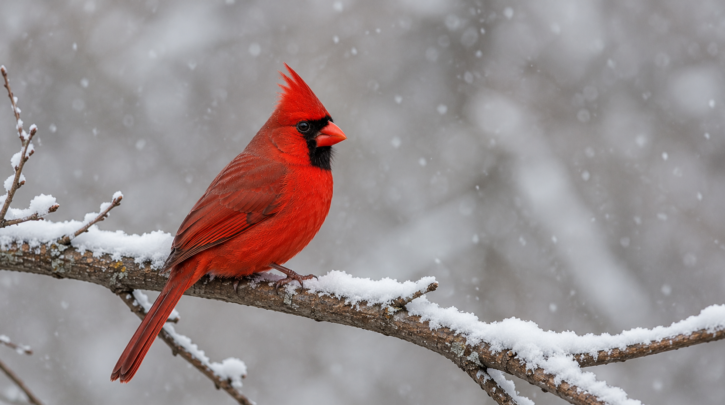

Northern Cardinals do not migrate. They’re year-round residents throughout their entire range, staying put through winter even in the cold northern reaches they’ve expanded into over the past century. This non-migratory lifestyle shapes almost everything about how cardinals live — and it’s a big part of why they’re such reliable, familiar backyard birds in every season.
The Short Answer: No
Unlike many songbirds that head south for winter, cardinals hold the same territory year-round. The cardinal at a feeder in July is very likely the same bird there in January. They don’t form large migratory flocks or make seasonal long-distance movements; instead, a pair or small group stays within a relatively small home range throughout the year, defending and using the same territory across all four seasons.
How Cardinals Survive Winter Without Migrating
Staying north through winter requires real adaptation. Cardinals rely on a combination of strategies: fluffing their feathers to trap insulating air, shivering to generate heat, seeking dense cover to escape wind and cold, and — critically — finding enough high-energy food to fuel the metabolism that keeps them warm. Their strong preference for high-fat seeds like black oil sunflower is directly tied to this need, and cold-weather feeding can genuinely help; see our winter guide for cold-season specifics.
Winter Flocking
While cardinals don’t migrate, their social behavior does shift in winter. During the coldest months, the strong territorial behavior of breeding season relaxes somewhat, and cardinals may gather in loose groups — sometimes a dozen or more birds — at good food sources, tolerating each other far more than they would in spring. These loose winter congregations break up again as breeding season approaches and males reassert territorial boundaries.
Why Staying Put Works for Cardinals
Migration is costly and dangerous, and for a bird that can survive winter in place with the right food and cover, staying avoids those risks entirely. Cardinals’ generalist diet — seeds, fruit, and whatever insects are available — lets them find food year-round in temperate habitats, and their attachment to dense cover gives them shelter from winter weather. For a species with these traits, year-round residency is a viable and even advantageous strategy compared to the hazards of long-distance migration.
What Non-Migration Means for Backyard Feeding
Because cardinals stay all year, a feeder isn’t just a spring-and-summer attraction — it’s a resource the same birds may rely on through the hardest part of winter, when natural food is scarce and the energy demands of staying warm are highest. This makes consistent year-round feeding, and especially reliable winter feeding, more meaningful for cardinals than for migratory species that simply leave when conditions turn harsh.
The Range Expansion Connection
The cardinal’s northward range expansion over the past century is directly tied to its non-migratory habits. Because cardinals don’t migrate, moving into colder northern areas meant surviving northern winters in place — something made more feasible by the spread of backyard bird feeding and milder winters. As covered in our habitat guide, this makes the cardinal a striking example of a resident species expanding its range alongside changes in climate and human activity.
Do Any Cardinals Move at All?
Cardinals may make small local movements — shifting to better cover or food sources within their general area, or young birds dispersing to establish their own territories — but these are minor, short-distance movements, not true migration. There’s no seasonal north-south journey of the kind that defines migratory species. For all practical purposes, a cardinal is a permanent local resident wherever it’s found.
How This Compares to Partial Migrants
Some backyard birds are partial migrants — species where northern populations move south while southern ones stay put — but cardinals aren’t even that. Across their entire range, from the Gulf Coast to the northern edge of their expanding territory, cardinals are consistently resident. This makes them a useful reference point for understanding what true non-migration looks like compared to the more common partial or full migration seen in many other feeder birds.
What to Watch for Through the Year
Because the same cardinals stick around all year, attentive backyard birders can watch a single pair move through the whole annual cycle — winter flocking and relaxed territoriality, the male’s ramping-up song in late winter, spring nesting, summer broods and fledglings, and fall’s return to heavier feeder reliance. Few backyard birds offer this kind of continuous, year-round observation of the same individuals; see our seasonal guides for what each part of the year brings.
That continuity is a genuine perk of the species — following one pair across an entire year turns a feeder into an ongoing story rather than a rotating cast of seasonal visitors.