
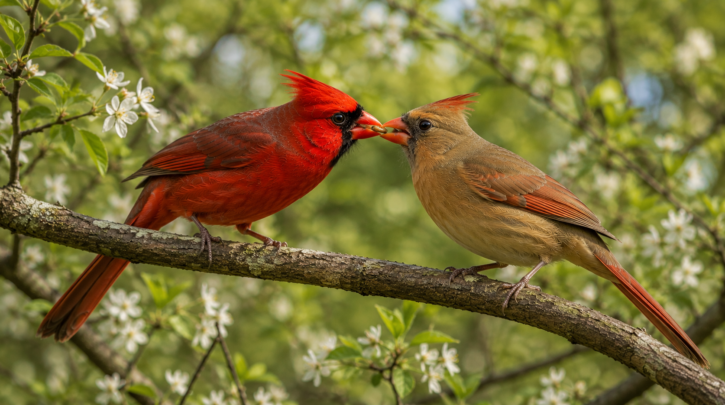

Male and female cardinals are different enough in color that new birders sometimes assume they’re looking at two species. Beyond plumage, one difference surprises people more than color ever does: female cardinals sing, a trait most female North American songbirds don’t share.
Plumage: Red vs. Brown
Males are solid red with a black face mask; females are pale brown to buffy tan with reddish-orange limited to the crest, wings, and tail rather than covering the body. Both sexes share the same crest shape and the same thick, conical orange-red bill as adults, which is why bill shape and crest, not color alone, are the more reliable way to confirm you’re looking at a cardinal at all; see our identification guide for how that plays out against look-alike species.
Why Females Aren’t Simply a Duller Male
The female’s coloring isn’t a washed-out version of the male’s — it’s a genuinely different, cryptic pattern suited to a bird that spends far more time low in dense cover near the nest, where blending in matters more than display. The male’s job leans more toward territory defense and mate attraction from visible perches, which favors the opposite strategy: standing out rather than disappearing into foliage.
Females Sing — A Real Rarity
Female cardinals regularly sing full, complex songs, often from the nest itself, which is unusual among North American songbirds where singing is typically a male-only behavior tied to territory and mate attraction. Female cardinal song is thought to serve a more practical purpose too, sometimes signaling to a mate when she needs him to bring food to the nest, which makes it functionally different from the male’s territorial song even when the sound itself is similar.
Bill Color Confirms Age, Not Sex
Both adult males and adult females have the same bright orange-red bill; the distinguishing factor for bill color is age, not sex. A darker, grayish bill on a brown-plumaged bird indicates a juvenile rather than an adult female, regardless of which sex that juvenile will turn out to be once it matures.
Courtship Feeding
During courtship and into incubation, male cardinals feed females directly, bill to bill, a behavior sometimes called mate-feeding or courtship feeding that’s genuinely charming to watch at a feeder and reflects the pair-bonded, biparental structure of cardinal breeding more broadly — both parents stay involved well beyond mating, unlike species where the male’s role ends after fertilization; see our nesting guide for how that shared investment continues through incubation and chick-rearing.
Size Is Nearly Identical
Unlike some bird species where one sex is noticeably larger, male and female cardinals are close enough in overall size and weight that size alone isn’t a useful way to tell them apart. Plumage and, for juveniles, bill color remain the more reliable cues.
Quick Field Checklist
- Solid red body, black face mask — adult male
- Buffy tan-brown body, reddish tinge on crest/wings/tail — adult female
- Brown plumage with a dark, grayish bill — juvenile of either sex
- Singing from a low, hidden perch — could be either sex, unlike most songbirds
Why This Species Is a Useful Case Study
Cardinals are a genuinely useful example for understanding sexual dimorphism in birds more broadly, since the plumage difference is dramatic enough to notice immediately, but the underlying reasons — nest concealment for females, display and territory defense for males — are far more subtle and worth understanding rather than just memorizing which color goes with which sex.
Telling Them Apart in Flight
At a glance in flight, the color difference remains the most reliable cue even without a clear look at the bill or crest — a flash of solid red is a male, while brownish plumage with any warm reddish tone in the wings or tail is a female. Both sexes show the same general silhouette and crest shape in flight, so shape alone won’t separate them the way color reliably does.
What This Means at a Mixed Feeder
At a feeder hosting several cardinals at once, the mix of solid red males and duller females is often actually a mated pair or family group rather than an unrelated crowd, since cardinal pairs frequently feed together and juveniles may still be trailing a parent well after fledging. Watching how birds interact — whether one seems to be following or being fed by another — can reveal social structure that plumage alone doesn’t show.
Taken together, plumage, bill color, and behavior give a far more complete picture than color alone ever could.