
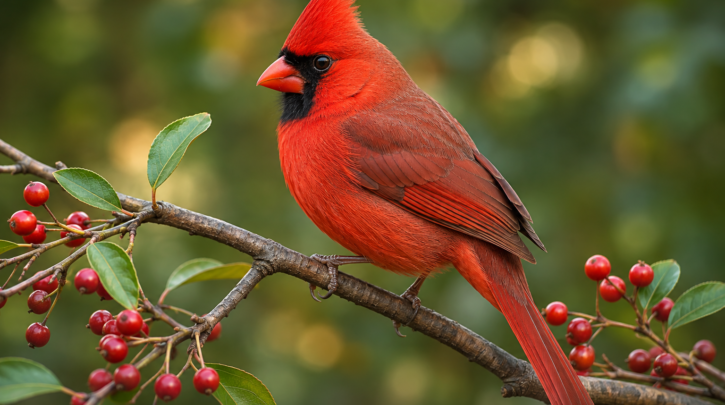

Cardinals are common enough that it’s easy to overlook how genuinely unusual some of their traits are among North American songbirds. Below are 25 facts grouped by physical traits, behavior, range, and cultural status — the kind of details that hold up to a second look rather than the exaggerated claims that circulate online.
Physical Traits
- Male cardinals are solid red with a black face mask; females are pale brown-tan with reddish highlights on the crest, wings, and tail.
- Both sexes have the same thick, cone-shaped bill, built specifically for cracking open sunflower seeds and other hard seed.
- Cardinals run about 8.75 inches long with a 9-to-12-inch wingspan, larger and stockier than many common feeder birds.
- The crest is erectile — raised when alert or agitated, flattened when relaxed.
- Juveniles have a dark, grayish bill rather than the adult’s bright orange-red one, which fades in over their first few months.
Behavior
- Female cardinals sing full, complex songs — a genuine rarity among North American female songbirds, where singing is usually a male-only trait.
- Male cardinals feed females bill-to-bill during courtship and incubation, a behavior called mate-feeding.
- Cardinals are monogamous and biparental — both parents help raise the young, unlike species where the male’s involvement ends after mating.
- Cardinal pairs often stay together across multiple breeding seasons rather than re-pairing each year.
- Cardinals are frequently among the first birds active at dawn and the last active at dusk, a pattern sometimes called being crepuscular feeders.
Range and Non-Migration
- Cardinals are non-migratory — they’re present in their territory year-round; see our range guide for what that means for winter feeding.
- Their range has expanded steadily northward and westward over the past century, a shift often linked to backyard bird feeding and a warming climate.
- The Pyrrhuloxia, found in the desert Southwest, is the closest look-alike species, distinguished mainly by its curved, yellowish bill.
- Cardinals range south into Mexico and parts of Central America, not just the eastern and central United States most people associate with them.
Cultural Status
- The Northern Cardinal is the official state bird of seven US states — Illinois, Indiana, Kentucky, North Carolina, Ohio, Virginia, and West Virginia — more than any other bird species.
- Its bright red color has made it a common holiday and winter symbol in North America, frequently appearing on greeting cards and decorations.
- The bird lends its name to Major League Baseball’s St. Louis Cardinals and the NFL’s Arizona Cardinals.
Diet and Feeder Behavior
- Black oil sunflower and safflower seed are cardinals’ strongly preferred feeder foods; see our feeding guide for the full diet breakdown.
- Cardinals generally prefer platform or hopper feeders with a sturdy perch over small tube feeders, since their larger body needs more stable footing.
- Beyond seed, cardinals eat a substantial amount of insects and fruit, particularly during breeding season when chicks need more protein.
- Cardinals typically visit feeders in pairs or small family groups rather than large flocks, reflecting their territorial, pair-bonded social structure.
- A cardinal’s thick bill generates enough force to crack seed shells that many smaller-billed feeder birds can’t open on their own.
A Common Myth, Corrected
A persistent bit of folklore holds that seeing a cardinal is a visit from a deceased loved one, a sentiment that’s genuinely widespread in American culture but isn’t a claim this guide can evaluate one way or the other — what’s worth knowing from a purely practical standpoint is that cardinals are simply common, visible, non-migratory residents in a lot of backyards, which is why sightings feel frequent and meaningful regardless of how someone chooses to interpret them.
Why Cardinals Became So Culturally Prominent
Part of the reason cardinals show up so often in folklore, sports branding, and holiday imagery comes down to simple visibility: a bright red bird against snow or bare winter branches stands out more dramatically than almost any other common backyard species, and because cardinals don’t migrate away for winter, that striking image is available in exactly the season — cold, gray, snow-covered — where a flash of red draws the most attention.
None of that cultural weight changes the underlying biology, but it’s a large part of why cardinals are so instantly recognized even by people who don’t otherwise follow birds closely.