
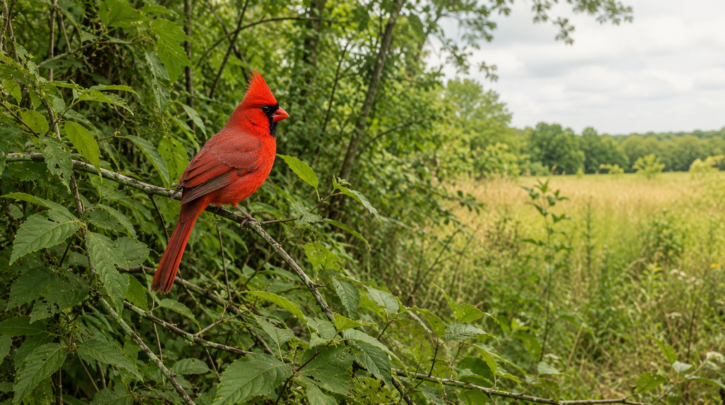

Northern Cardinals are birds of edges and thickets — the brushy, semi-open spaces where woodland meets field, and increasingly the suburban and residential yards that mimic that structure. They’ve thrived alongside human development in a way many birds haven’t, and their range has expanded steadily northward over the past century, making habitat one of the more genuinely interesting parts of the cardinal story.
Preferred Natural Habitat
Cardinals favor woodland edges, overgrown fields, hedgerows, thickets, and streamside tangles — transitional zones with dense low cover rather than either deep unbroken forest or wide-open ground. This edge habitat provides the mix they need: shrubby cover to nest and shelter in, open areas to forage, and elevated perches for the male to sing from. The dense, twiggy structure matters more than the specific plant species, which is why cardinals adapt so readily to human-modified landscapes that recreate that structure.
Suburban and Residential Yards
Few birds have taken to suburban life as successfully as the cardinal. A typical residential yard — with foundation shrubs, hedges, ornamental trees, and a feeder or two — closely mimics the edge-and-thicket habitat cardinals evolved in, and the year-round food that backyard feeding provides has helped them flourish in developed areas. This adaptability is a big part of why cardinals are among the most familiar backyard birds across the eastern and central United States.
The Northward Range Expansion
A century ago, the Northern Cardinal was largely a southern bird. Over the past hundred-plus years, its range has expanded dramatically northward, reaching the northern United States and into parts of southern Canada where it was once absent. Two factors are usually credited: the spread of backyard bird feeding, which provides reliable winter food in colder regions, and a warming climate that has made northern winters more survivable for a non-migratory bird. The expansion is one of the better-documented examples of a species’ range shifting alongside human activity.
Range Across the Continent
Today cardinals are found across the eastern and central United States, south through Texas and into Mexico and parts of Central America, and westward into the desert Southwest, where they overlap with the similar Pyrrhuloxia. They’re absent from most of the western US, including the Pacific states and the northern Rockies, though their range continues to shift. Within their range they’re non-migratory residents, present in the same areas year-round rather than moving seasonally.
What a Cardinal-Friendly Habitat Provides
- Dense low cover — shrubs, hedges, and thickets for nesting and shelter, the single most important element
- Elevated song perches — taller trees or structures the male can sing and watch from
- Reliable food — natural seeds and berries plus feeder seed; see our feeding guide
- Water — for drinking and bathing year-round, including through winter
Habitat and Behavior Together
Cardinals’ habitat preferences directly shape how they behave at a feeder. Their attachment to cover explains why they feed most confidently near shrubs and are quick to retreat into them when startled, and why a feeder placed out in the open sees less cardinal activity than one near a hedge. Understanding the habitat is, in practice, understanding how to set up a yard the birds will actually use; see our feeder guide for how placement near cover ties into feeder choice.
Supporting Cardinals Through Habitat
The most durable way to attract cardinals isn’t a single feeder but a yard structured like the edge habitat they prefer — layered plantings with dense shrubs for cover, taller trees for perches, and natural food sources supplementing a feeder. This kind of habitat supports cardinals through their entire year-round life cycle, from winter survival to spring nesting, in a way a feeder alone never could.
Cardinals and Climate Change
The cardinal’s ongoing northward push is frequently cited by researchers as a visible, backyard-scale example of how a warming climate reshapes species ranges. Because cardinals are non-migratory and depend on surviving winter in place, milder winters directly expand where they can live year-round, and their steady advance into previously too-cold regions tracks alongside both warming trends and the spread of winter bird feeding. Few range shifts are as well documented or as easy for ordinary observers to notice over a lifetime.
Habitat Threats
Despite their adaptability, cardinals aren’t immune to habitat loss — clearing of hedgerows, thickets, and woodland edges for development or intensive agriculture removes exactly the dense cover they depend on. The good news is that their tolerance for suburban and residential landscapes means thoughtful backyard planting genuinely helps offset those losses, making individual yards a meaningful part of the habitat network that supports local cardinal populations.