
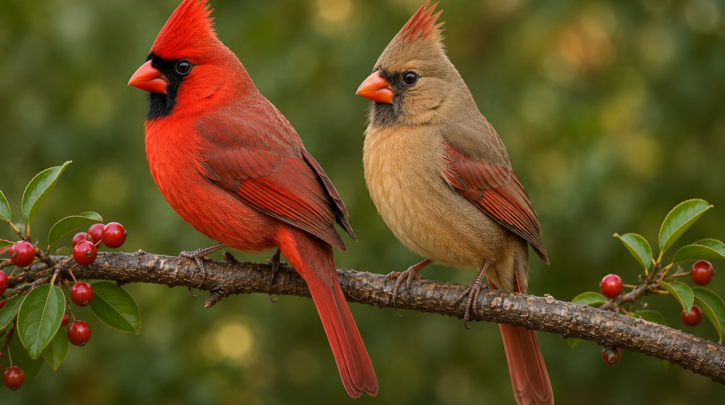

A male Northern Cardinal is about as close to an unmistakable bird as North America has — solid red body, black face mask, and a crest, with no realistic look-alike across almost its entire range. The identification questions that actually come up are about everything else: females, juveniles, and one genuine look-alike species in the desert Southwest.
Male Cardinals: The Easy Case
Adult male cardinals are brilliant red overall, with a black mask covering the face, chin, and area around a thick, cone-shaped orange-red bill, plus a prominent pointed crest that can be raised or flattened depending on the bird’s mood. There’s no other backyard bird across most of the cardinal’s range that combines that much solid red with a crest, which is exactly why cardinals are so often the bird people already know before they know any other species.
Female Cardinals Look Completely Different
Females are pale brown to buffy-tan overall rather than red, with warm reddish-orange tinges limited to the crest, wings, and tail, and the same thick orange-red bill and crest shape as the male. This is a bigger visual gap between sexes than in most backyard birds, and it’s common for people watching a feeder to assume a female cardinal is an entirely different species until the bill shape and crest give it away; see our male vs female guide for the full comparison.
Juveniles Have a Dark Bill
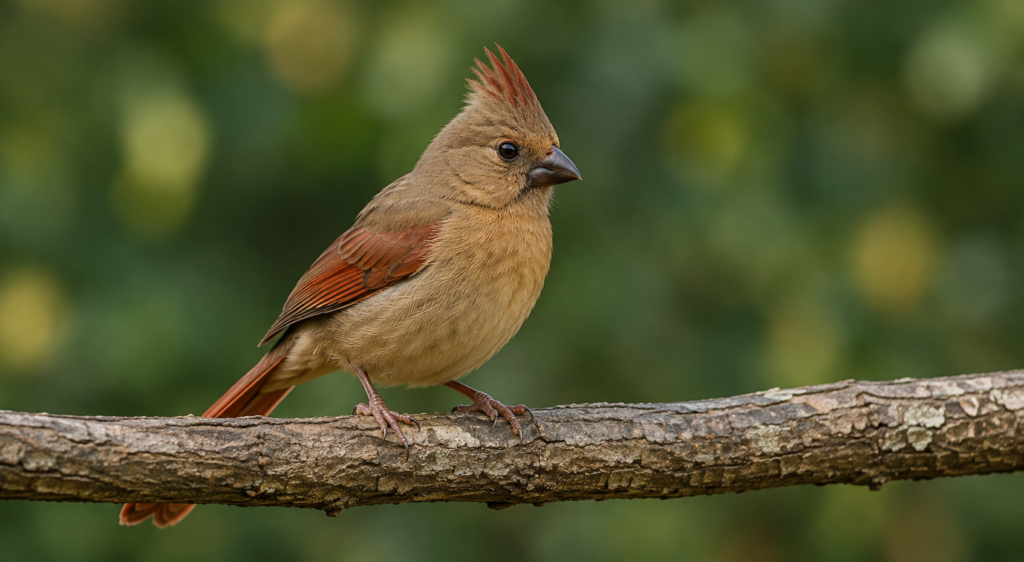
Young cardinals resemble females in overall plumage but have a dark grayish or blackish bill rather than the adult orange-red one, which is the fastest way to tell a juvenile from an adult female at a glance. The bill gradually shifts to the adult orange-red color as the bird matures over its first few months, so a duller-billed “female” at a late-summer feeder is often actually a young bird of either sex rather than an adult female.
The One Real Look-Alike: Pyrrhuloxia
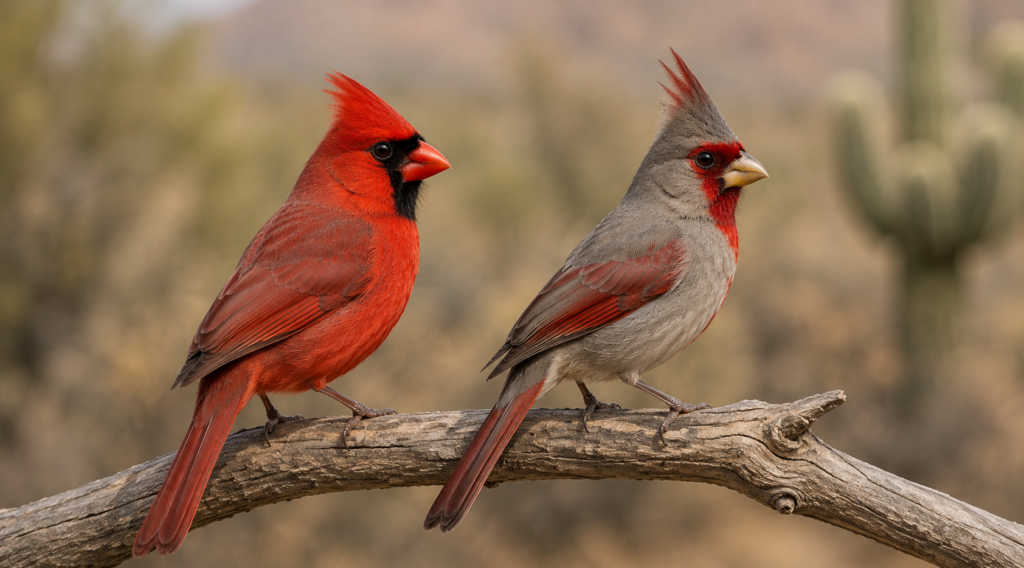
In the desert Southwest, particularly Arizona, New Mexico, and south Texas, the Pyrrhuloxia is a genuinely similar species — crested, similarly sized, with red highlights on an otherwise gray body, and males show red on the face, crest, and underparts against a gray back. The clearest separator is bill shape: the Pyrrhuloxia’s bill is more curved and yellowish rather than the cardinal’s straight-sided, uniformly orange-red cone. Outside the Southwest’s overlap zone, this confusion simply doesn’t come up, since the two species’ ranges barely intersect.
Size and Shape
Cardinals run about 8.75 inches long with a wingspan of roughly 9 to 12 inches, noticeably larger and stockier than many common feeder birds like chickadees or finches. The thick, conical bill — built for cracking sunflower and other hard seed — is a useful shape cue on its own, distinct from the thinner bills of most other red-toned feeder visitors.
Why Identification Is Mostly About Confirming, Not Narrowing Down
Unlike migratory species where the identification challenge is sorting out several possible visitors passing through at once, cardinals are present year-round across their entire range, which means the question at a feeder is almost never “which species is this” so much as “is this a male, female, or juvenile.” See our range guide for how that year-round presence shapes what you’ll actually see through the seasons.
The Crest as a Behavioral Signal
Beyond identification, the crest itself is worth watching — cardinals raise it when alert, agitated, or displaying, and flatten it when relaxed or preening, which makes it a rough mood indicator as much as a field mark. A cardinal with a fully raised crest at a feeder is often responding to a nearby threat or a territorial rival rather than simply feeding calmly.
Seasonal Plumage Changes
Unlike many songbirds that molt into a distinct breeding plumage, cardinals keep essentially the same coloring year-round, with only minor wear making feathers look slightly duller by late winter before a fresh molt restores brightness. This is convenient for identification purposes, since there’s no need to learn a separate winter or breeding-season appearance the way there is for some other species.
Regional Consistency
Because cardinals don’t migrate, the birds at a feeder in January look essentially identical, plumage-wise, to the birds at the same feeder in July — there’s no seasonal turnover in which individuals or even which general appearance you’re seeing, unlike a migratory species where winter and summer visitors can differ. Consistent year-round presence, described in more detail in our range guide, is part of what makes cardinals such a reliable identification anchor species for new birders.