
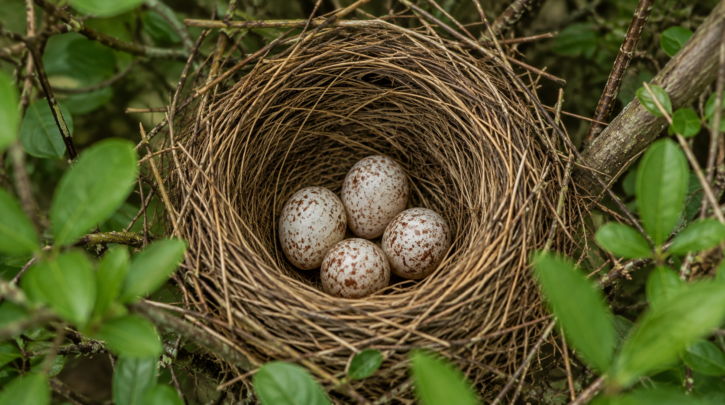

Cardinal eggs are pale grayish or greenish-white with brown and gray speckling, laid in clutches of usually three to four, and incubated mainly by the female for around 11 to 13 days. Compared to the two-egg clutches of some birds, cardinals invest in larger clutches and multiple broods, which shapes how their whole breeding season plays out.
What Cardinal Eggs Look Like
Cardinal eggs are roughly an inch long, pale grayish-white to greenish- or buffy-white, marked with speckles and blotches of brown, gray, and lavender that are often concentrated toward the larger end. The speckling provides camouflage against predators when the female is briefly off the nest. The coloring can vary somewhat between individual females, but the overall speckled, pale pattern is consistent enough to be recognizable.
Clutch Size
A typical cardinal clutch is three to four eggs, occasionally two or five. This is a larger clutch than some backyard birds lay, and combined with the two or three broods a pair often raises per season, it reflects a breeding strategy built around producing a good number of young across a long season rather than concentrating everything into a single small clutch.
Incubation
The female does most or all of the incubating, sitting for roughly 11 to 13 days while the male defends the territory and brings her food. This male-feeding behavior during incubation is part of what allows the female to stay on the eggs consistently, keeping them at a stable temperature without having to leave frequently to forage for herself. Incubation doesn’t begin in earnest until the clutch is complete or nearly so, which helps the eggs hatch close together.
Hatching
Eggs generally hatch within about a day of each other after the incubation period, producing a synchronized brood rather than chicks of widely different ages. The hatchlings emerge helpless — blind, nearly naked, and entirely dependent on both parents for warmth and food; see our baby cardinal guide for what happens through the nestling and fledgling stages.
What to Do If You Find a Nest With Eggs
Leave it alone and observe from a distance. Cardinal eggs and nests are federally protected, and close disturbance genuinely risks the female abandoning the clutch, especially early in incubation. Resist the urge to check frequently — even well-intentioned monitoring can stress a nesting pair, and a nest that’s approached repeatedly by a person may also draw the attention of predators following human scent trails or activity to the spot.
Nest Failure and Re-Nesting
Not every clutch succeeds — cardinal nests are vulnerable to predators, storms, and other disturbances, and nest failure is a normal part of the breeding season. When a nest fails, a pair will typically try again, building a new nest and laying a fresh clutch. This willingness to re-nest, combined with multiple planned broods, is part of how cardinal populations stay stable despite the high natural failure rate of individual nests; see our predators guide for the main threats to nests and young.
Brown-Headed Cowbird Parasitism
Cardinal nests are sometimes targeted by brown-headed cowbirds, which lay their own eggs in other birds’ nests and leave the host to raise them. A cowbird egg in a cardinal nest — typically larger and more heavily speckled than the cardinal’s own — can hatch sooner and produce a chick that outcompetes the cardinal nestlings for food. Cardinals don’t generally recognize and reject cowbird eggs, so this parasitism is a genuine pressure on nesting success in some areas, though it’s a natural dynamic rather than something a backyard birder should intervene in, since cowbird eggs are also federally protected.
How Egg Color Provides Camouflage
The speckled, pale coloring of cardinal eggs isn’t decorative — it breaks up the egg’s outline against the nest lining and dappled light filtering through shrub cover, making a clutch harder for a visually hunting predator like a jay or snake to spot during the brief periods the female is off the nest. This is the same camouflage logic behind the female’s own cryptic brown plumage, which keeps a sitting bird concealed on the nest.
How Many Eggs Survive to Fledge
Even in a successful nest, not every egg necessarily produces a fledgling — some eggs may fail to hatch, and young nestlings can be lost to predation or poor weather before leaving the nest. This is exactly why cardinals lay larger clutches and attempt multiple broods across a long season: the strategy is built around the reality that a meaningful share of eggs and nestlings won’t make it, so producing more across several attempts is how the pair reliably raises replacement young each year.