
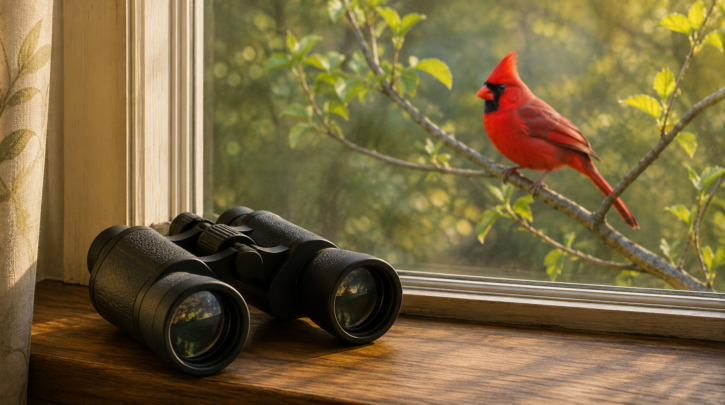

A male cardinal doesn’t leave much room for doubt. Solid red, a crest, a black mask around a thick orange bill — you can make that call from the far side of the yard, through a window, past a dirty windshield. It’s often the very first bird a brand-new backyard birder learns to name on sight, no field guide required. Which raises a fair question: if you can already tell what it is from fifty feet away, what exactly are binoculars supposed to do for you?
The One Bird You Never Actually Need to Identify
Most birding optics guides start from the assumption that you need help telling species apart. Cardinals break that assumption. The male’s coloring isn’t subtle, isn’t seasonal camouflage, isn’t a case of “similar species” causing confusion — there’s nothing else in most of the country that looks like it. Even the duller female, with her warm tan body and red-tinged crest and wings, is distinctive enough that most people place her correctly on a second or third sighting, especially once she’s seen next to a male. For the full rundown on telling the two apart, see our male vs. female identification guide.
That’s part of why cardinals are so often the reason someone buys their first pair of binoculars in the first place — not because they need help naming the bird, but because the bird is already interesting enough, and close enough, that a better look feels worth chasing. If you’re still working out field marks on trickier species, our cardinal identification guide covers those, but this article is about a different question entirely.
So What Are Binoculars Actually For, Then?
If identification isn’t the job, the job becomes something closer to noticing. A cardinal at twenty feet with the naked eye gives you color, shape, general behavior. The same cardinal through even a modest pair of binoculars gives you texture — individual feather edges, the exact state of the crest, whether the bill looks freshly bright or slightly worn, whether two birds at the feeder are actually interacting with each other or just happen to be nearby at the same time. None of that changes what species you’re looking at. All of it changes how much you actually see.
Watching Molt Happen in Real Time
Cardinals go through a single full molt a year, usually late summer into fall, and a fair number of them lose their head feathers all at once rather than gradually — a genuinely strange-looking stage covered in detail in our guide to bald cardinals. From across the yard, a molting cardinal just looks a little rough. Through binoculars, you can watch the actual progression: bare skin, then short dark pin feathers emerging, then color slowly filling back in over a couple of weeks. It’s a genuinely different experience to track that process day by day rather than just clocking “looks scruffy” from a distance.
Reading the Female’s Subtler Palette
The male cardinal’s color is a single, unmissable signal. The female’s is a conversation — warm olive-brown shading into red on the crest, wings, and tail, with the exact balance varying noticeably from bird to bird. At a glance, she reads simply as “the brownish cardinal.” With a closer look, individual females start to look genuinely different from each other, in a way that flat, quick glances tend to flatten out entirely. This is where binoculars start doing something naked-eye viewing structurally can’t: not confirming what species you’re looking at, but letting you actually see the bird in front of you instead of the general idea of one.
Catching the Bill’s Seasonal Shift
One detail almost no one notices without a closer look: a cardinal’s bill isn’t a fixed, constant orange year-round. Many birders who watch the same resident pair closely season after season notice the bill running a touch duller through the leanest part of winter and brightening up heading into spring, alongside the general uptick in condition and activity that comes with longer days and the start of courtship. It’s a subtle enough shift that it’s easy to miss entirely at a distance, and genuinely satisfying to actually track once you know to look for it.
Catching Courtship Feeding Between a Pair
This is arguably the single best argument for picking up binoculars specifically for cardinals. Watch a paired male and female close enough, at the right time of year, and you’ll sometimes see him pass a seed directly into her bill — a courtship behavior covered in full in our cardinal courtship guide. It happens fast, at close range, and it’s easy to miss or misread with the naked eye from across a yard. Through binoculars, it’s unmistakable, and it’s the kind of moment that turns “I saw a cardinal today” into something you actually want to tell someone about.
The Real Case: None of this is about needing binoculars to know what bird you’re looking at. It’s about how much of a cardinal’s actual behavior — molt, courtship, the individual character in a female’s coloring — is simply too small or too fast to catch with the naked eye alone.
Who This Is Actually For
If you’re feeding cardinals at a window a few feet away, or already running a camera feeder that catches close-range footage, binoculars may genuinely add very little to your specific setup. But if your cardinals mostly show up across the yard, in a tree line, or in a thicket at the property edge — or if you’ve caught yourself wishing you could see a bit more of what a pair is actually doing together — a first pair of binoculars is a low-cost way to find out.
What to Look For in a First Pair (Not a Serious-Birder Pair)
The gear advice for a dedicated birder chasing warblers through dense canopy and the gear advice for someone who wants a better look at the cardinals already visiting their yard are not the same advice, even though most buying guides treat them as identical. A first pair bought specifically for a bird you already recognize should optimize for a different set of priorities.
| What to Prioritize | Why It Matters for a First Pair |
|---|---|
| Moderate magnification (7x-8x, not 10x+) | Easier to hold steady with no experience; higher magnification amplifies hand shake |
| Simple, fast center focus wheel | A cardinal at a feeder doesn’t wait around while you fumble with independent focus |
| Close focus around 8-10 feet | Backyard cardinals are often close; long-range-only optics waste that advantage |
| Rubber-armored, durable housing | A first pair gets dropped, knocked off a windowsill, left out in weather |
| Budget price point ($50-$150) | No reason to spend serious money before you know how often you’ll actually use them |
A Few Genuinely Beginner-Friendly Options
- Celestron Nature DX 8×42 — the frequent default recommendation for a first “real” pair, with clear optics and a comfortable focus wheel well above what the price usually buys
- Occer or similar compact 8×21-8×25 models — small, light, inexpensive, and genuinely fine for casual backyard use, though the smaller objective lens shows its limits in low light
- Bushnell H2O 8×42 — a budget-friendly, waterproof option that holds up well to being left near a window or taken outside without much babying
Any of these will resolve a cardinal’s molt stage, feather detail, and courtship behavior far beyond what the naked eye picks up. Spending more only starts to matter once you’re using them often enough, and in different-enough conditions, to notice the difference — which is a decision worth making after a season of actual use, not before.
Where to Buy
B&H Photo carries the full range of birding-focused brands mentioned here, with detailed specs and optics-specific staff and reviews rather than the incidental accessory treatment binoculars get on a general marketplace.
The Bird Doesn’t Need You to Have Binoculars
A cardinal at your feeder is exactly as much of a cardinal with or without a pair of 8x42s hanging around your neck. Nothing here changes that identification was never the problem. What changes is how much of what that cardinal is actually doing — molting, courting, showing off a female’s particular shade of red — you’re equipped to catch. For more on what that behavior looks like across the whole year, our year-round cardinal guide is a good next stop.