
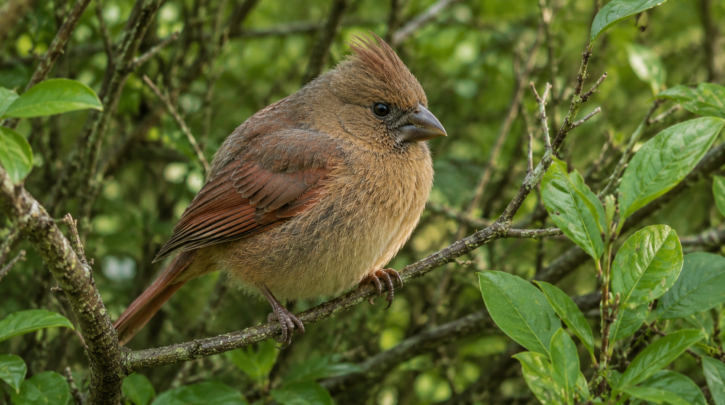

Baby cardinals hatch blind and nearly naked and develop fast — leaving the nest in as little as 9 to 11 days, well before they can fly strongly. Both parents feed them, and the male often takes over care of the fledglings while the female starts the next brood, a handoff that’s central to how cardinals raise multiple families in a season.
What Hatchlings Look Like
Newly hatched cardinals are altricial — born helpless, with closed eyes, little or no down, and a complete dependence on their parents for warmth and food. In the first days they can’t regulate their own body temperature and rely on the female brooding them in the nest. Growth is rapid from the start, with feathers beginning to come in within the first several days and eyes opening within roughly the first week.
How Both Parents Feed the Young
Unlike species where one parent handles feeding, both the male and female cardinal feed the nestlings, delivering insects and other protein-rich food to fuel rapid growth. This is where a pesticide-free yard with a healthy insect population genuinely matters — nestling cardinals need far more protein than the seed-heavy adult feeder diet provides; see our feeding guide for how the diet shifts toward insects during breeding season.
The Fast Nestling Stage
Cardinals grow quickly enough to leave the nest just 9 to 11 days after hatching, a short nestling period typical of open-cup-nesting songbirds whose exposed nests make a fast exit safer than a longer stay. By fledging, the young are feathered but still show the duller, brownish juvenile plumage and, notably, a dark grayish bill rather than the adult’s orange-red one — the key field mark for identifying a young cardinal, covered in our identification guide.
Fledglings Leave Before They Can Fly Well
Cardinal fledglings typically leave the nest before they can fly strongly, spending their first days out of the nest hopping among low branches and ground cover while their flight develops. This is a normal and vulnerable stage — a fledgling on the ground or a low branch, being fed by a parent nearby, is not abandoned or in trouble even though it looks defenseless.
The Male Takes Over
A key feature of cardinal parenting is the handoff: once the first brood fledges, the male often takes over feeding and tending the young while the female begins building a new nest and laying the next clutch. This lets the pair overlap broods and raise more young per season, and it’s why you’ll sometimes see a male cardinal feeding several trailing, begging fledglings on his own during summer.
How Long Until Independence
Fledglings continue to be fed by the parents for several weeks after leaving the nest, gradually learning to forage on their own before becoming fully independent. During this stretch, young cardinals slowly transition from the brownish juvenile plumage and dark bill toward adult coloring, a process that unfolds over their first few months as they mature into recognizable adult males and females.
What to Do If You Find a Baby Cardinal
A feathered young cardinal hopping on the ground or perched low is almost always a normal fledgling with a parent nearby, and the best action is to leave it alone and keep pets away. A truly featherless or clearly injured nestling found on the ground is a different situation — if it can be done safely and the nest is known and reachable, it can be gently placed back, since the notion that parent birds reject touched young is a myth. If the nest can’t be reached or the bird is injured, contacting a licensed wildlife rehabilitator is the right step rather than attempting to raise it, which is both illegal without a permit and rarely successful.
Watching Fledglings Safely
Summer is the best time to watch young cardinals, as fledglings follow parents around the yard and gradually learn to use feeders. The main thing a backyard birder can do to help is keep cats indoors and maintain a clean, reliable food and water source, since clumsy young fliers are especially vulnerable to predation in their first weeks out of the nest. A camera feeder can be a rewarding way to document this stage, capturing the transition from begging, dark-billed juvenile to independent adult over the course of a season.
It’s one of the most rewarding stretches of the backyard cardinal year — a direct look at how the next generation of feeder visitors comes to be.