
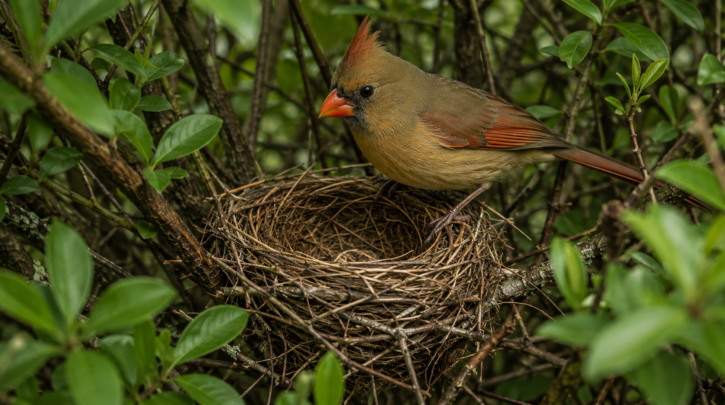

Cardinals nest low in dense shrubs and thickets, with the female doing the building while the male defends the territory and helps feed once chicks arrive. A pair commonly raises two broods in a season, sometimes three, which means cardinal nesting activity stretches across a long stretch of spring and summer rather than a single brief window.
Who Builds the Nest
The female builds the nest largely on her own, though the male often accompanies her and sometimes brings nesting material. This is a more shared arrangement than in many bird species — cardinals are monogamous and both parents stay involved through the whole breeding cycle, unlike species where the male’s role ends at mating. The male’s main contributions during nest-building are guarding the territory and feeding the female, a behavior that continues from courtship through incubation; see our male vs female guide for how that pair bond shapes their behavior.
Where Cardinals Nest
Nests are typically placed low — often just three to ten feet off the ground, sometimes a little higher — in dense shrubs, small trees, thickets, and tangles of vines. The defining feature is concealment: cardinals favor spots with thick surrounding foliage that hides the nest from predators and provides shelter. This is exactly why a yard with dense native shrubs draws nesting cardinals more reliably than one with feeders but little cover; see our plant guide for the kinds of shrubs that provide good nest sites.
Nest Structure and Materials
A cardinal nest is an open cup, typically built in four layers: a foundation of coarse twigs, a layer of leaves or bark strips, a lining of grapevine bark or similar fibers, and a final soft lining of fine grasses, rootlets, or hair. The female often bends twigs with her bill and shapes the cup by pressing with her body. Nests are generally used for a single brood rather than reused, with the pair building fresh for each new clutch.
Multiple Broods Per Season
Cardinal pairs commonly raise two broods in a breeding season, and in southern parts of their range with long warm seasons, sometimes three. Often the male takes over feeding the newly fledged young from the first brood while the female begins building a new nest and starting the next clutch, an efficient division of labor that lets the pair overlap broods and fit more nesting attempts into a season.
The Breeding Timeline
Cardinal breeding generally runs from around March into August or September, varying by latitude, which is a long season driven partly by their non-migratory, year-round presence on territory. Pairs often form or reaffirm bonds well before nesting begins, and the male’s spring singing helps establish and defend the territory the nest will sit within; see our spring guide for how the season opens.
How to Support Nesting Without Disturbing It
The most useful thing a backyard birder can do is provide dense shrubby cover and then leave it alone during breeding season. Cardinal nests, eggs, and young are protected under the Migratory Bird Treaty Act, and beyond the legal point, repeated close disturbance risks a female abandoning a nest. If a nest turns up in a shrub that needs trimming, the right move is to wait until the brood has fledged before doing that work.
Will Cardinals Use a Nest Box?
Cardinals are open-cup nesters, not cavity nesters, so they won’t use an enclosed birdhouse or nest box the way bluebirds, chickadees, or wrens do. Some birders offer open-fronted nesting shelves or platforms, which cardinals occasionally use, but the far more reliable way to encourage nesting is simply providing dense shrubs and thickets. Putting up a standard nest box for cardinals is effort spent on the wrong kind of structure entirely.
Signs Cardinals Are Nesting Nearby
A few behaviors hint that a pair is nesting close by: a female repeatedly carrying nesting material into the same shrub, a male making frequent feeding trips to a fixed spot, or increased territorial singing and chasing from the male through spring and early summer. Rather than searching the shrubbery directly, which risks disturbing an active nest, watching these flight patterns from a distance is the low-impact way to confirm nesting activity.
Why Cardinals Stay Put Year-Round
Because cardinals don’t migrate, a nesting pair is often defending and using essentially the same territory they occupied through the winter, which means the birds visiting a feeder in January may well be the same pair nesting in a nearby shrub come May. This year-round residency gives a well-set-up yard a real advantage for attracting nesting cardinals: birds that already know the territory, its food sources, and its cover are more likely to nest within it than birds arriving fresh each spring.