
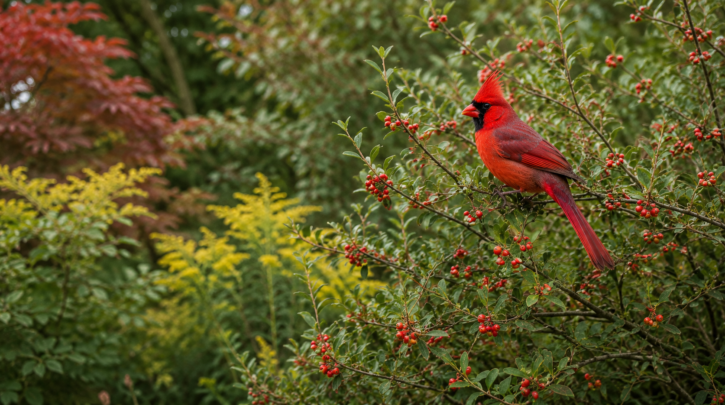

A feeder brings cardinals in, but the right plants are what make a yard genuine cardinal habitat — providing natural food, the dense low cover they feel safe in, and nesting sites. Cardinals are birds of forest edges and shrubby thickets, so the most useful plantings recreate that structure while supplying berries, seeds, and the insects that round out their diet.
Why Cover Matters as Much as Food
Cardinals are cautious birds that stay close to protective cover and nest low in dense shrubs and thickets. A yard with feeders but no nearby cover often sees fewer cardinals than one with modest food but good shrubby structure, since the birds simply feel too exposed. Dense native shrubs do double duty — providing both the cover cardinals want and, in many cases, berries or seeds they eat; see our nesting guide for how that cover supports breeding specifically.
Berry-Producing Shrubs
- Dogwood (Cornus species) — native dogwoods produce berries cardinals eat and provide excellent structure
- Serviceberry (Amelanchier) — early summer berries taken by cardinals and many other birds
- Elderberry (Sambucus) — prolific late-summer berries and dense growth
- Wild grape (Vitis) — fruit plus tangled cover cardinals favor for nesting
- Sumac (Rhus) — persistent seed heads that provide winter food when other sources are scarce
Seed-Producing Plants
Beyond berries, plants that produce seed cardinals eat are worth including, particularly native sunflowers and other composite flowers whose seed heads cardinals will work over directly. Leaving these seed heads standing into fall and winter rather than cutting them back provides natural food during exactly the season when a non-migratory bird most needs it.
Dense Shrubs for Nesting and Cover
For the cover and nesting side specifically, dense, twiggy shrubs and small trees matter most — cardinals typically nest low, within a few feet to a dozen or so feet off the ground, in tangled shrubs, thickets, and vines. Native options like viburnum, hawthorn, and dense hedgerow plantings give them the concealed, protected nest sites they prefer, close enough to a feeder to fold the whole yard into one usable territory.
Avoid Invasive Shortcuts
Some fast-growing shrubs marketed for quick cover or berries — certain bush honeysuckles, autumn olive, and multiflora rose among them — are invasive across much of North America and spread aggressively into natural areas, often via the very birds that eat their berries. Native alternatives provide the same structure and food without that ecological cost, and a regional native plant nursery or extension office can point to the best local options.
Skip the Pesticides
Because insects are a real part of the cardinal diet, especially for feeding nestlings, a pesticide-free yard supports cardinals in a way no feeder can. Broad-spectrum insecticides remove a critical protein source right when breeding cardinals need it most, so tolerating some insect activity in the garden directly benefits the birds; see our feeding guide for how insects fit into their overall diet.
Layering the Habitat
The most cardinal-friendly yards combine layers — taller trees for song perches and safety, dense mid-level shrubs for nesting and cover, and seed- or berry-producing plants for food — rather than relying on any single plant. This layered structure mirrors the forest-edge habitat cardinals evolved in, and a feeder set within it becomes one food source among several rather than the only reason a cardinal visits the yard.
Planting for Year-Round Value
Because cardinals are present every month of the year, the most useful plantings provide something across multiple seasons rather than a single burst — early-summer serviceberry, late-summer elderberry, and persistent-seed plants like sumac that hold food into winter together cover a far longer stretch than any one species. A yard planned for staggered fruit and seed availability supports cardinals through the lean winter months when a feeder and natural food together matter most.
Small-Space and Container Options
A full shrub layer isn’t possible everywhere, but even a small yard or patio can contribute — a single dense native shrub near a feeder provides meaningful cover, and a large container of native seed-producing flowers left to go to seed in fall offers natural food. The priority in tight spaces is cover close to the feeder, since a cardinal that feels safe approaching is worth more than an extra food source it’s too exposed to use.
Even one well-placed native shrub can be the difference between a cardinal that passes through and one that settles in, making cover the highest-value planting in almost any space.